
When you slip a glittering ring onto your left ring finger, you are participating in a tradition that spans thousands of years. As the ultimate symbol of romance, devotion, and a promise for the future, the engagement ring holds a timeless allure. But what is the real story behind it, and how did this gleaming tradition actually begin?
The journey of the engagement ring is far more fascinating and practical than we realize. From ancient legal contracts to royal fashions and modern trends, let’s explore the rich history of the engagement ring.
Ancient Roots: From Reeds to Iron Bands
Long before diamonds were a girl’s best friend, ancient civilizations were using rings to signify commitments.
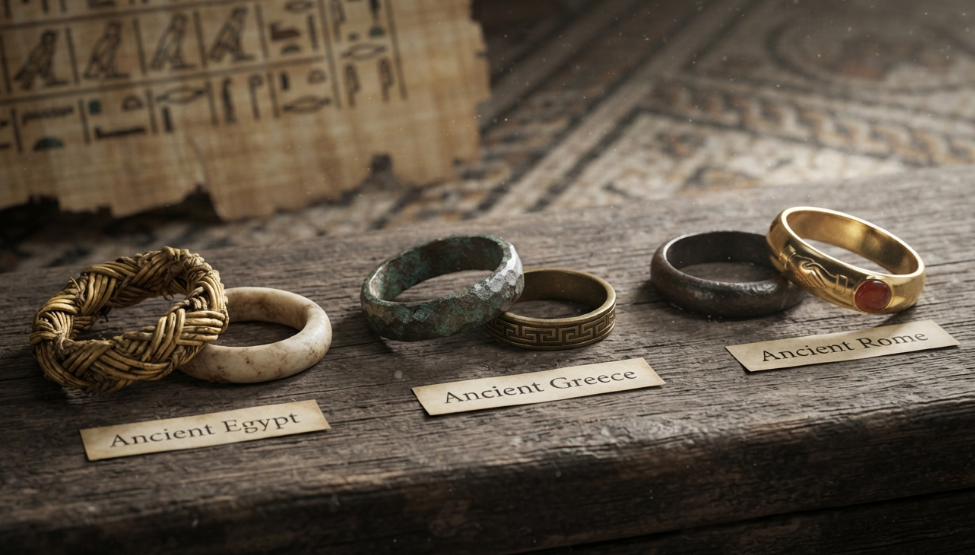
- Ancient Egypt: Historians trace the earliest iteration of the first engagement ring back to the ancient Egyptians, who believed that circles symbolized eternity because they had no beginning and no end. They crafted rings out of woven reeds, hemp, leather and bone, and these simple circles were exchanged as tokens of love and commitment. The ring was worn on the fourth finger of the left hand because the Egyptians believed—erroneously, as we now know—that a “vein of love” ran directly from that finger to the heart. The Romans would later call this vein the “Vena Amoris,” a romantic notion that persists to this day.
- Ancient Greece & Rome: The ancient Greeks adopted the tradition, often using rings made of iron or bronze. For the Greeks, the ring was a symbol of the unending nature of love and the circular journey of life. The Romans, ever the pragmatists, added a twist. Roman brides were given two rings: a practical iron ring to wear at home while managing the household, and a gleaming gold ring to wear in public to showcase the family’s social status. Far from being mere tokens of romance, these rings served a serious legal function. A Roman man would present a ring to his future bride’s father as a gesture of binding the marriage contract—a “earnest” or “pledge” that sealed the deal. In both cases, the ring signified a binding agreement. The emotional meaning was secondary to its practical, legal function.
Medieval & Renaissance: From Ownership to Romance (9th to 17th Century)
As Christianity spread throughout Europe, the engagement ring took on new religious significance. The Church encouraged the giving of rings as a physical symbol of the spiritual union between a man and a woman. By the 9th century, Pope Nicholas I explicitly stated that the ring was a necessary part of the betrothal ceremony.
Along with this spiritual elevation came a dramatic shift in craftsmanship. Precious gold and silver replaced utilitarian iron, while jewelers introduced vibrant gemstones packed with symbolism—sapphires for faithfulness, rubies for passion, and emeralds for hope.
This era also birthed some of the most romantic and inventive designs in jewelry history:
Fede Rings: Showcasing two hands clasped in partnership, these intricate designs became the quintessential Renaissance token of loyalty and betrothal.
Poesy Rings: Popular throughout the Middle Ages, these simple gold bands featured short verses or romantic phrases in French or Latin engraved secretly on the inside for the couple’s eyes only.
Gimmal Rings: A product of Renaissance ingenuity, these featured two or three interlocking hoops that fit seamlessly together to form a single band, frequently serving as combined engagement and wedding rings.
The First Diamond Engagement Ring (1477)
This is the moment that changed everything.
In 1477, Archduke Maximilian of Austria—who would later become Holy Roman Emperor—proposed to Mary of Burgundy, one of the most sought-after brides in Europe. To win her hand, Maximilian commissioned a very special ring: a diamond set in a flat band of gold, with diamonds arranged to form an “M.”
This is the first recorded diamond engagement ring in history.
Why was this so significant? At the time, diamonds were rarer than almost any other stone. They were mined primarily in India and were considered almost mythical in their durability. By offering a diamond ring, Maximilian wasn’t just making a romantic gesture—he was demonstrating his immense power, wealth, and seriousness.
The gesture captured the imagination of European royalty and nobility. Suddenly, a diamond engagement ring was not just a gift; it was a statement. It said: “I love you so much that I will give you the rarest and hardest substance on Earth—because my love is equally rare and unbreakable.”
The Victorian Era: The Language of Sentiment(19th Century)
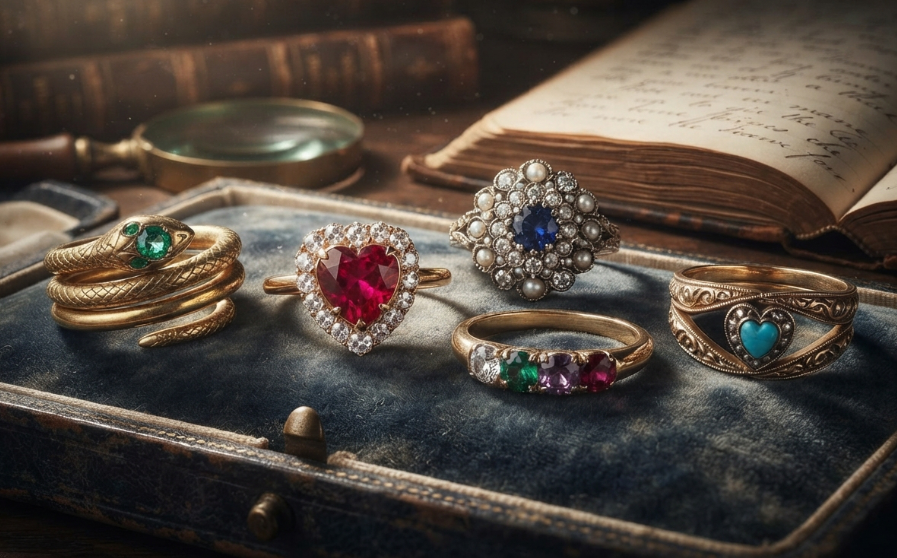
The 19th century transformed the engagement ring into an art form, largely thanks to trendsetter Queen Victoria. When Prince Albert proposed to Queen Victoria with a serpent-shaped ring set with an emerald (her birthstone), the fashion world immediately followed suit. Victorian engagement rings were deeply sentimental, frequently featuring colorful gemstones like rubies, sapphires, and amethysts, often clustered with diamonds or pearls to form floral motifs. During this era, jewelry design prioritized emotion and storytelling over mere monetary value.
Engagement rings became far more elaborate and symbolic:
- Heart-shaped rings expressed romantic devotion.
- Snake rings (with the serpent forming a circle) symbolized eternity and wisdom.
- Floral designs used the language of flowers to convey secret messages.
- Birthstones and acrostic rings (where the first letter of each gem spelled a word like “DEAR” or “LOVE”) were highly fashionable.
The Modern Diamond Era: A Brilliant Marketing Turn
The modern diamond engagement ring as we know it is largely a product of the 20th century.
South African Discoveries (Late 1800s)
While diamonds had been discovered in South Africa, near the Orange River in the late 1800s, they were rare and reserved for the ultra-wealthy. This discovery triggered a diamond rush unlike anything the world had ever seen. The supply of diamonds exploded. For the first time in history, diamonds were no longer the exclusive preserve of kings and queens. The emerging middle class could now afford a diamond engagement ring—if not a large one, then at least a modest one.
The stage was set for the modern diamond engagement ring. But it would take one more element to truly cement its place in popular culture.
De Beers Campaign (1947)
In the 1930s, the De Beers diamond cartel faced a severe crisis. The Great Depression had devastated the global economy, sending sales plummeting while the company sat on massive stockpiles of uncut stones.
Enter the N.W. Ayer advertising agency, hired to revive the collapsing market with a revolutionary strategy: inventing a modern tradition. In 1947, copywriter Frances Gerety unveiled an unforgettable slogan—“A Diamond Is Forever”—which permanently linked the gem to the concept of eternal love.
By transforming a luxury good into a psychological necessity, the campaign reframed the diamond on multiple levels: its physical hardness became a metaphor for an unbreakable bond, its permanence implied that any marriage without one was incomplete, and its high resale value was dismissed to position the ring as a lasting financial asset rather than a fleeting expense.
Backed by these brilliant psychological tactics—along with the industry-wide popularization of standard ring sizing, modern diamond cuts, and the classic solitaire setting—the diamond ring quickly became the immutable global standard for modern proposals.
Today Engagement Rings
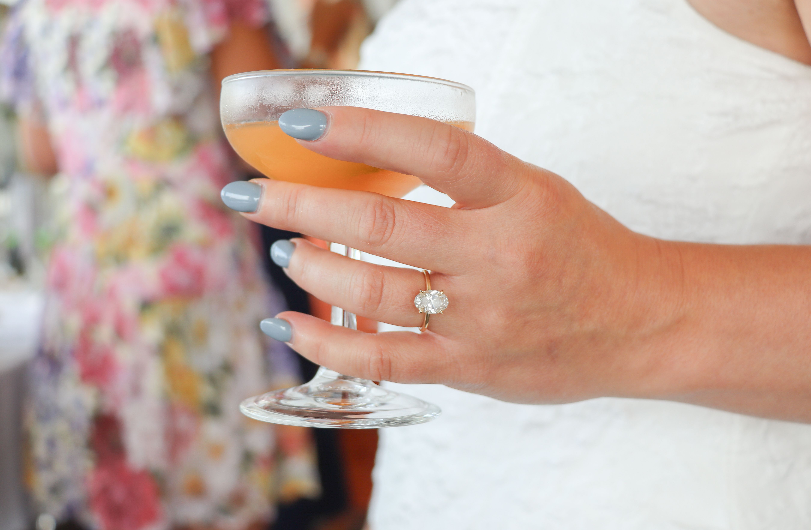
The landscape of the engagement ring has continued to evolve. Today, couples increasingly prioritize personal expression, ethical sourcing, and individuality over rigid tradition.
Modern engagement rings are defined by a blend of timeless classics and progressive choices:
- The Rise of Lab-Grown Diamonds: Advancements in technology have made chemically identical, conflict-free lab-grown diamonds a popular, sustainable, and budget-friendly alternative to mined stones.
- Alternative Gemstones: Sapphires, emeralds, moissanite, and salt-and-pepper diamonds are experiencing a massive resurgence, allowing couples to break away from the traditional clear diamond.
- Personalized and Custom Designs: Rather than opting for mass-produced settings, modern buyers frequently mix vintage aesthetics with modern minimalist geometry, designing bespoke rings that tell their unique relationship story.
- Ethical Sourcing and Recycled Metals: Beyond the center stone, conscious consumers increasingly prioritize supply chain transparency, conflict-free mining, and the use of recycled gold or platinum to minimize environmental impact.
From a legal contract in antiquity to a modern symbol of personal identity, the engagement ring stands as a powerful mirror of shifting social values, technological progress, and enduring human emotion. It has witnessed history and love alike, and it will continue to do so.
More Jeulia Post: